Ticket number format + metric card padding STAGING
Narong's Order Management item 10 (red-flagged 2026-07-24) and item 5. nix-cafe only. No migration.
His asks:
- "Show Ticket Number & Hide Order #"
- "Tweak UI and Ticket Format (Showing what is shown on the ticket not the full Order Number)"
- "The metrics cards are chopped off/have no margins."
The ticket number
Order numbers are stored as {prefix}-{seq} — POS07-0003 (Pro), BKK1-0003
(Starter shop code) or F-0003 (operator register prefix). Every surface was rendering the whole string.
Now the sequence leads, because that's the number staff and customers actually say out loud.
| Surface | Before | After |
|---|---|---|
| Order Management table | #POS1000000000-0002 | #0002 + Register 1000000000 |
| Order details modal | same, in the header | #0002 (large) + register |
| Kitchen Display (wall screen) | POS1000000000-0002 | #0002 + register |
| Printed customer receipt | Order: POS…-0002 | Order: #0002 (1000000000) |
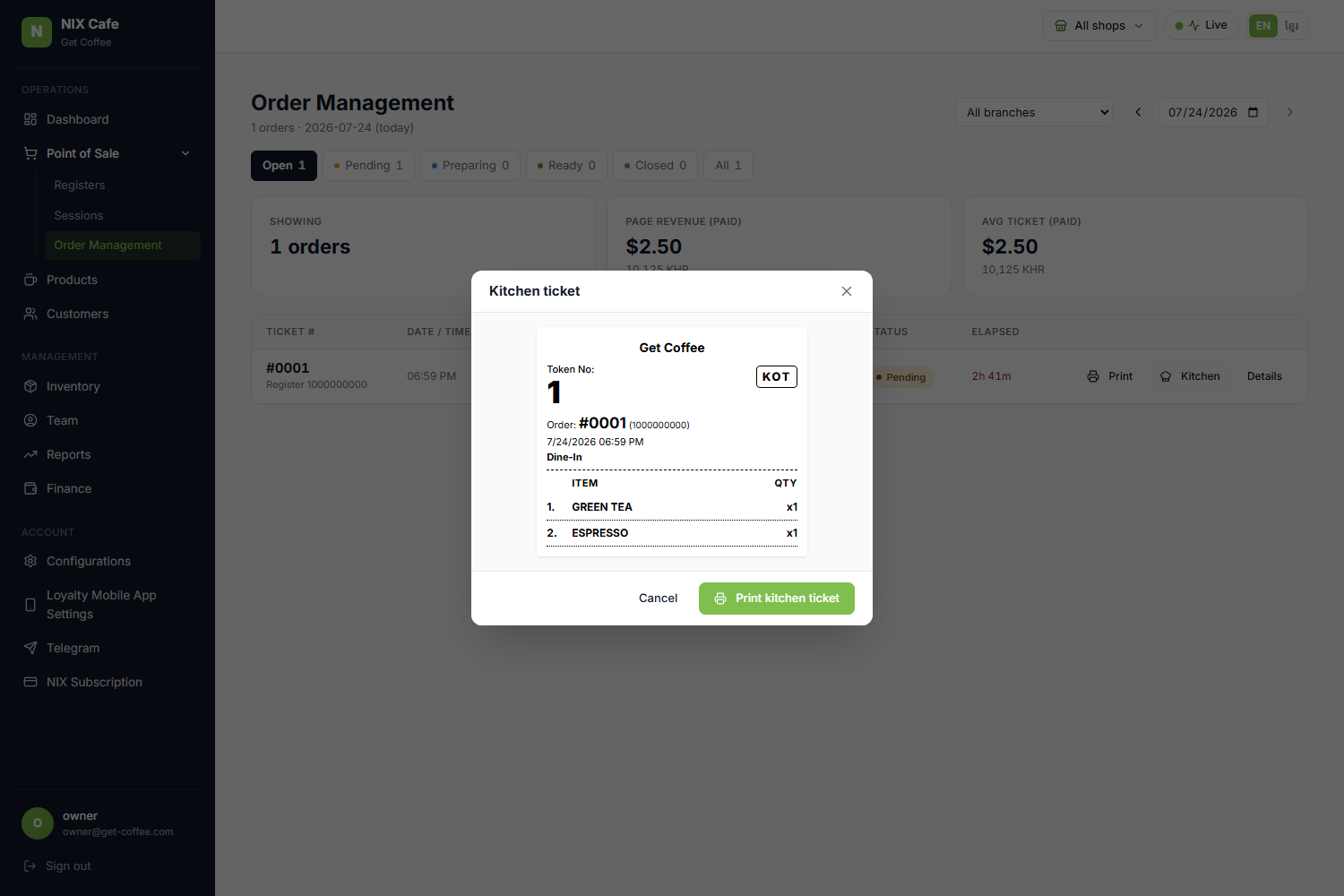
| Printed kitchen ticket (KOT) | Order: POS…-0002 | same treatment |
Why the register prefix is kept, not dropped
The sequence resets per register per day — and every shop on staging runs two
registers. A bare #0002 would therefore appear on two different live tickets in the same shop on the
same day, which staff couldn't tell apart. So the sequence is shown prominently with the register beside it
rather than the prefix being removed outright.
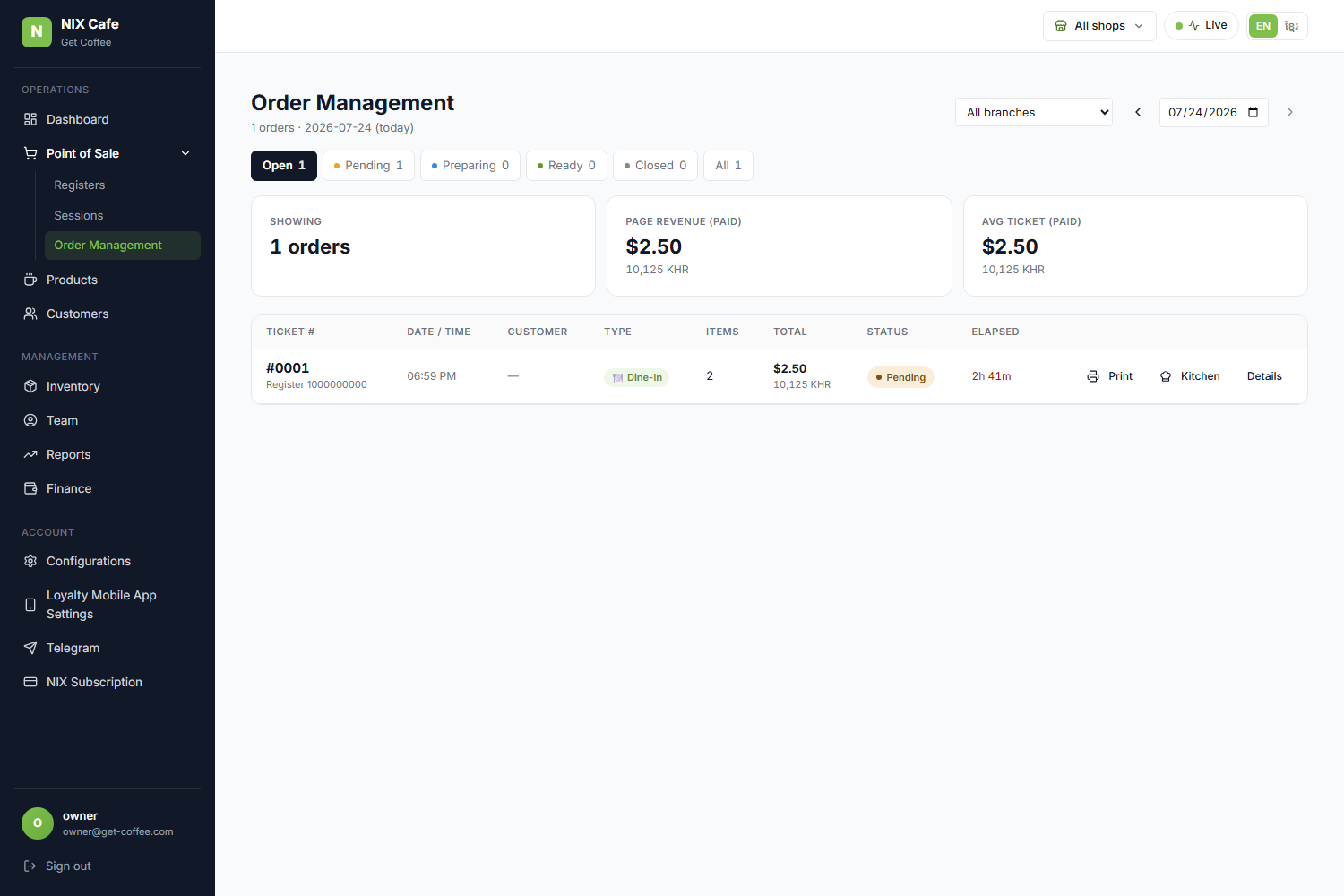
get-coffee.staging — the Ticket # column leads with the sequence, register underneath, and the metric cards have padding again.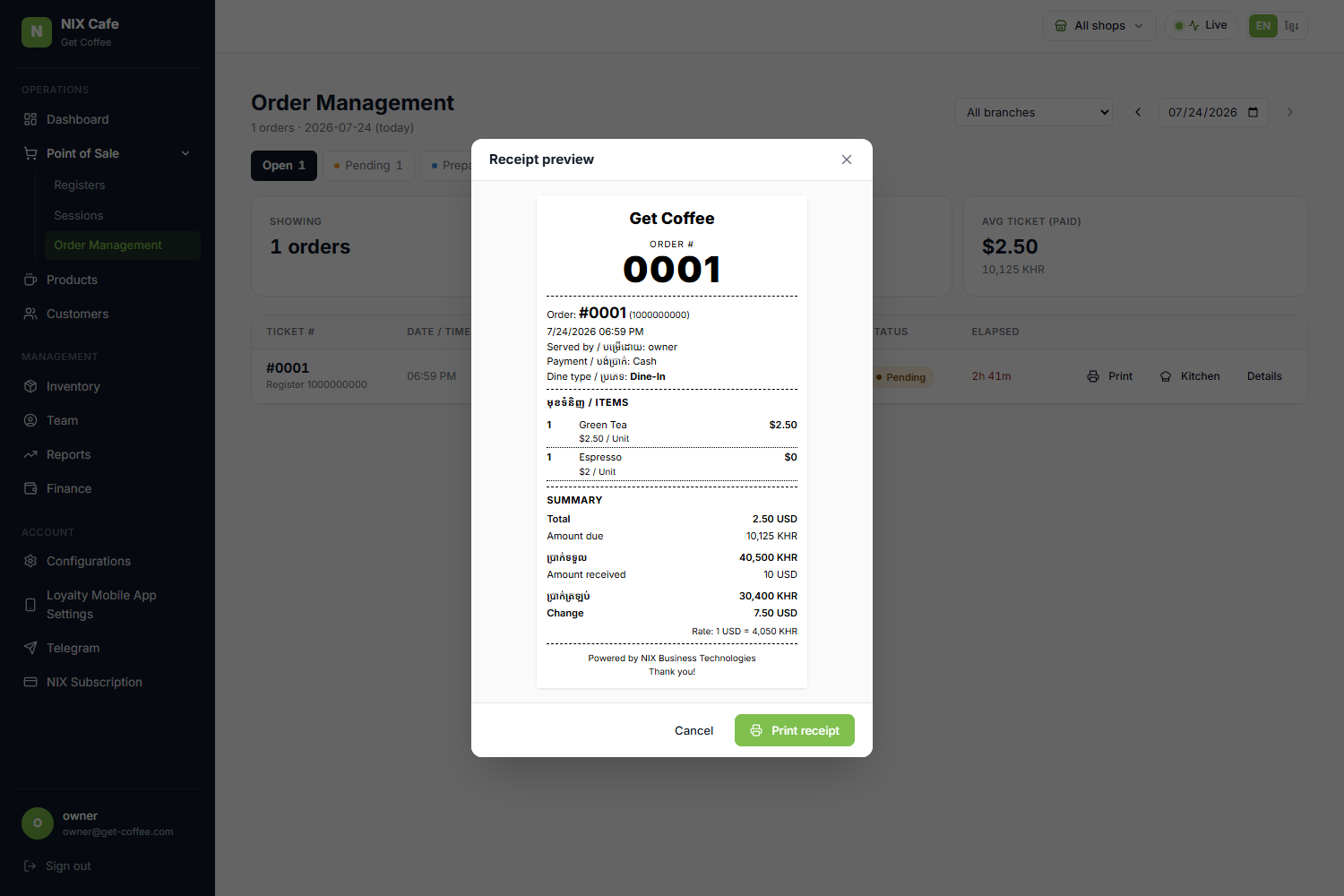
The metric cards — a real defect, not a style tweak
The shared Card component ships with no padding of its own; every caller supplies it
(p-10 for the empty state, an explicit padding: 0 for the table). The
Metric card passed none, so its content sat flush against the border — exactly "chopped
off/have no margins". Now p-5, matching the dashboard KPI cards. The test asserts computed
paddingLeft rather than eyeballing it.
One parser, not two
A helper for this already existed — shortenOrderNumber in lib/order-number.ts, used by the
POS tab strip and orders history. Its docstring even recorded the old policy: "receipts, Kitchen Display
and exports stay on the full prefixed form" — precisely what Narong reversed. So the new
parseTicketNumber lives in that same file and shortenOrderNumber now delegates to it,
rather than a second copy being introduced. (A duplicated date helper is what forced this morning's timezone bug to be
fixed in two places.)
Legacy order numbers pass through untouched
Real rows exist with a dash inside the prefix and a non-numeric suffix — e.g.
LEGACY-1778337843955-A, UNIQ-1778337843955-B. These don't match
{prefix}-{digits} and are rendered unchanged rather than mangled. There's an explicit test for it, and
one is visible in the local screenshot as #UNIQ-….
Checks
| Suite | Result |
|---|---|
Local — parser across all 3 shapes + legacy + nullish, shortenOrderNumber regression guard, DOM + computed padding | 7/7 |
| Staging — table, register qualifier, padding, printed receipt, printed KOT | 6/6 |
| Staging smoke | 5/5 |
tsc --noEmit | clean |
The assertions are self-proving: each checks that no cell or printed body still matches
POS\d+-\d+, which would have failed outright on the old code.
nix-cafe staging 7df13ac (Worker 2ff313d7). No migration. Parked for the
scheduled prod promote. ⚠️ This is the first change in the bundle that alters printed output customers
physically receive — worth Narong printing one on staging before the promote.